
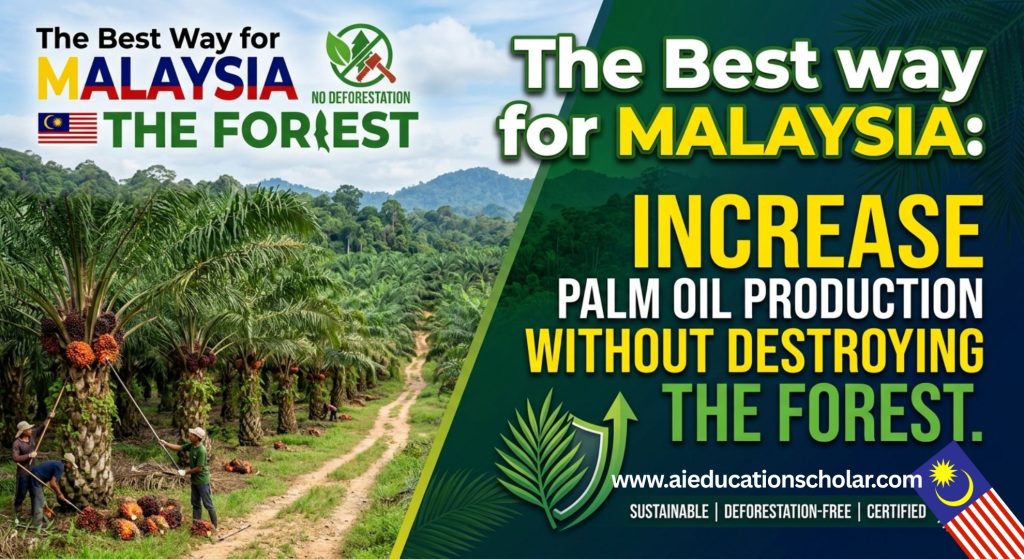
The Best way for Malaysia: Increase the Production of Palm oil without destroying the forest.
Abstract
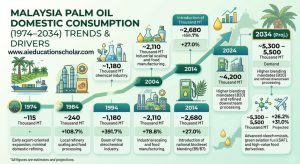
Malaysian palm oil demand can be increased to 4200 thousand metric ton 5300 thousand metric ton within the year of 2034. In general Malaysia need more land for increasing the palm oil demand which can be easy if he destroy forest. But Malaysia need to increase palm oil production without destroys forest. Malaysia can raise Production of Palm oil without further deforestation by combining yield‑intensification (replanting, improved seedlings, Good Agricultural Practices), smallholder support and finance, landscape planning and protection, and certification and market incentives. This write up try to evaluate those different measures and proposes an integrated policy package that prioritizes replanting, agro‑intensification, and stronger enforcement to achieve additional supply while conserving forests.[2][1]
Introduction, Production of Palm oil
Palm oil is a deal for Malaysia they export a lot of it and it helps people in rural areas make a living. In the past growing more palm oil hurt the rainforests. The palm oil market in Malaysia is not just for people it is a product that can be sold all around the world. Palm oil is a product that can be exported and sold in countries.
When the new development plan came, for the new demand fulfill they need to produce more tree and land. So Malaysia has been focused on getting palm oil from the land they already have but it is not sufficient. On the other hand cutting down more trees cannot be more helpful. Production of Palm oil should be most important consideration in this study.
This study is about palm oil. It tells us how palm oil we can get from one hectare of land. It also helps people follow the rules. These rules help keep the market system fair. The market system makes sure people do not cut down forests. In Malaysia palm oil producers want to grow palm oil. They think palm oil is good for the environment. They want to produce palm oil in a way that is suitable, for the Malaysian environment. [4][3]
Problem statement, Production of Palm oil
Malaysia’s oil palm area is mature. Yields vary a lot, between estates and small landowners. Low productivity and old palms limit how much oil palm can be produced. This creates pressure to expand the oil palm area. The government and industry therefore face the dual challenge of increasing crude palm oil (CPO) output while halting further loss of natural forest. Recent Malaysian policy statements prioritize yield improvements and no new deforestation.[1][4]
Literature and policy background, Production of Palm oil
Malaysia is starting to plant palm oil trees in a planned and organized way. The government has programs to help small farmers who own their own land. These programs are for people who have pieces of land and want to grow palm oil trees. The goal is to stop cutting down trees and to focus on getting oil from the trees we already have. People who study this say we should plant trees that can produce a lot of oil. We should also use farming practices and make sure we are not hurting the environment.
This way we can produce palm oil without cutting down more trees. Malaysia wants to do things in a way that’s good for the earth and good, for the people who grow palm oil trees. [5][2][1]
Proposed integrated approach
I propose a four‑pillar strategy which mostly related of Production of Palm oil-
- Pillar 1 The people in charge will help the farmers use the fertilizer and machines to get more fruit from each farm. They also want to teach the farmers how to pick the fruit in the way. This will help get 30 to 50 percent oil palm fruit from each farm. The government is already helping the farmers by giving them money to replace trees and by teaching them new ways to farm. This way the farmers can give oil without using more land.
- Pillar 2 is about helping the farmers. The government will give them loans with interest rates and money to help them replace old trees. They will also teach the farmers ways to farm and help them work together. This will help the small farmers get better at farming and give them a chance to sell their fruit to people who want quality oil palm fruit. The government in Malaysia is already doing something like this.
- Pillar 3. They will also make a plan for the land so that the oil palm farms are on land that is already being used. This will help keep the forest safe and connect the parts of the forest that are already protected. The government in Malaysia does not want to cut down any trees.
- Pillar 4 is about making sure that the oil palm fruit is grown in a way that’s good for the environment. The people, in charge will help the farmers get a certificate that shows they are growing the fruit in a sustainable way. They will also help the farmers sell their fruit to people who want to buy oil palm fruit. This will help the farmers get money for their fruit and it will help the environment because the farmers will not have to cut down trees to get more land.
Implementation steps and policy instruments
- A national plan to replant palm trees is needed. This plan should focus on areas that will give the results and provide financial help through matched grants and low-interest loans. This will help the government achieve its goals for palm oil production. Malaysia already offers incentives for farmers, which can be expanded.
- Small farmers should work together. Some grant programs, in Malaysia have shown that this kind of support can work.
- There should be rules to prevent people from using land illegally and to monitor areas where palm trees are grown. This can be done by using technology to watch from space and doing checks on the ground. Malaysia has promised to stop contributing to deforestation and to focus on improving palm oil yields..[3][4]
Market linkages and certification scaling: Provide time‑limited premium payments or tax incentives for certified sustainable CPO and facilitate buyer–producer contracts that require no‑deforestation sourcing and reward higher yields on existing land. Certification strategies are recommended to drive both environmental and social outcomes.[5]
Expected outcomes and benefits
If implemented, the combined strategy can raise national production substantially without increasing planted area; analysts project significant potential gains from intensification and replanting alone. Improved yields will increase incomes for smallholders, reduce pressure to clear forests, and allow Malaysia to meet international sustainability expectations while maintaining export volumes. Recent industry estimates suggest Malaysia can lift CPO from current levels toward higher output through replanting and improved practices without deforestation.[3][2]
Challenges and risk mitigation
Key challenges include financing gaps for smallholders, slow replanting uptake, land‑tenure complexity, and global market price volatility. Mitigation measures include blended public–private finance, stronger extension programs, simplifying smallholder cooperation, and phased implementation with measurable targets and independent verification. Real‑time satellite monitoring and certification audits can reduce illegal conversion risk.[7][1]
Policy recommendations, Production of Palm oil
- Scale national replanting incentives and ensure seedling quality and extension support for smallholders.[1]
- Create blended finance facilities and cooperative aggregation to de‑risk smallholder investments.[1]
- Enforce no‑conversion rules, protect HCV/HCS forests, and use remote sensing for monitoring.[4][3]
- Need traceability and expand certification of national sustainability standards.[5]
Conclusion
Malaysia need raise Production of Palm oil without destroying forest. But current situation deserve sustainability in every development steps. So for palm oil production up-gradation need sustainable raise of palm oil production without destroying forest and increase profit and global production stake. Then Malaysia needs replanting to continue increment of production, finance & protecting remaining forests. An integrated package reduces incentive for expansion, secures livelihoods, and aligns Malaysian Production of Palm oil with global sustainability expectations.[4][2][1]
References
- Malaysian Palm Oil Industry performance and smallholder replanting programs.[1]
- Government statements prioritizing yield boosting and stopping contribution to deforestation.[4]
- Policy and industry analyses on targets for smallholder yield increases and the production potential without deforestation.[3][2]
- https://isp.org.my/v4/wp-content/uploads/2024/01/Malaysian-Palm-Oil-Industry.pdf
- https://insights.tridge.com/speaker-product-news-reports/KJLyFXpzJzgKuB1Gqsm5QUKHGgR43AVdqLfscSpDxTas5QM6jQf6wQns
- https://prestasisawit.mpob.gov.my/en/palmnews/news/39029
- https://www.mpoc.org.my/malaysia-to-prioritise-yield-boosting-stop-contributing-to-deforestation/
- https://asb.edu.my/wp-content/uploads/2024/02/Achieving-Sustainable-Development-An-NDPE-and-Certification-Strategy.pdf
- https://daresearch.com.my/assets/doc/DARE- Palm Oil Report_23042025.pdf
- https://ukragroconsult.com/en/news/malaysia-oil-palm-replanting-prioritised-to-boost-yield-without-expanding-land-use/
- https://www.asia-palmoil.com/post/malaysia-boosts-palm-oil-yields-without-new-deforestation-johari
- https://www.icheme.org/media/13103/20200106_loh_sustainable-po.pdf
- https://www.sciencedirect.com/science/article/abs/pii/S1462901124000054