
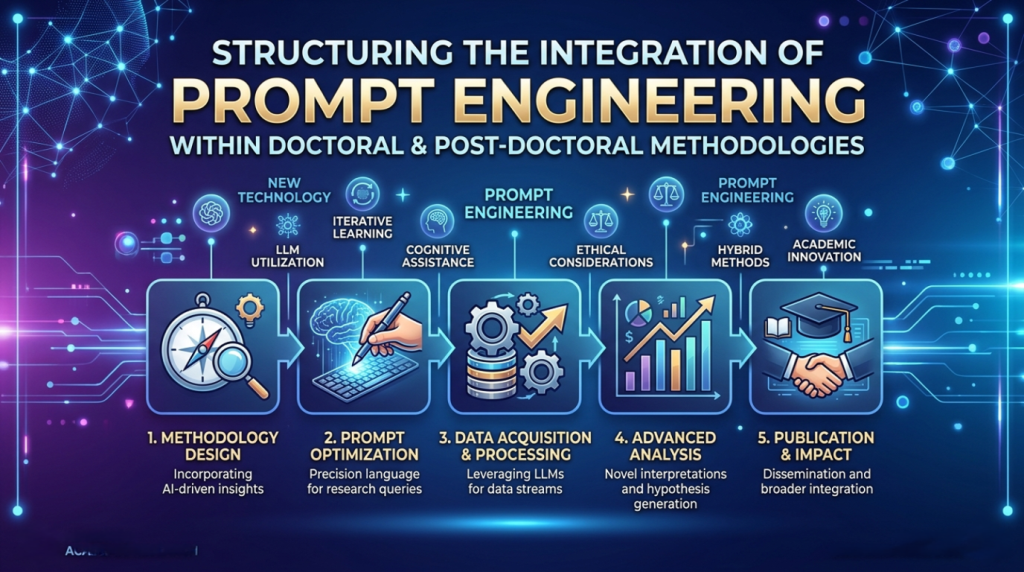
Structuring the Integration of Prompt Engineering within Doctoral and Post-Doctoral Methodologies
In modern age, the doctoral and post-doctoral research is showing that is a novel digital mix of the old traditional Pattern. In 2026, the question is generative AI or any AI model should be permitted in advanced academia or not. It can be systematically integrated without undermining methodological precision with consent of professor or any other authority.
At the highest tiers of academic research—such as PhD dissertations and post-doctoral grant development—the use of Large Language Models (LLMs) or any AI model can be represented a distinct methodological vulnerability.
For any accuracy maintenance of scientific research discovery for doctoral and post-doctoral advanced academia should consider human-AI interaction as a formal way of research and analysis. This writing is trying to explore how to use prompt engineering directly into doctoral and post-doctoral activity and direction of work, shifting AI usage from an initial shortcut to a new developed and existing research engine and AI automation system.
The Real-World Problem: The Reliability Crisis in AI-Assisted Research
The core idea of doctoral-level methodology is reliability. If any education researcher or any other researcher cannot follow an existing methodology and work with the same dataset or analytical conclusions, the research loses scientific existence or any validity.
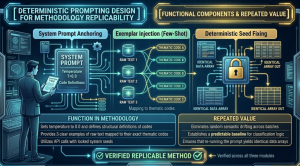
In the time of educational research doctoral or post-Doctoral Methodologies- researcher and candidates utilize commercial AI web system interfaces for coding, data transformation or gap finding. In this stage they can introduce an invisible problem to this standard of research activity and research data processing.
This “solution” of the research of doctoral and post-doctoral methodologies stage introduces three fundamental failures which are stated below:
1. Stochastic Drift and Dynamic Weighting: Large Language Model cannot predict by route of origin of system. The exact same system of prompt can enter today may give result of an altered thematic style tomorrow for the model which can update or active for external parameter variance (such as temperature fluctuations).
2. Sycophancy Bias: Some research models are naturally integrated into different way with the validate user input. If a researcher asks a Large Language Model to find evidence which can support a highly unique, borderline exclusive hypothesis and the model will often extensive its result for agreement to flatten the different variation of conflicting analysis.
3. Context Window Rot and Token Spillover: The research and research methodology in selective weights information near the real beginning or prompt of artificial intelligence which can make a massive analytical gap in the core data.
On the other hand, without a structured research framework of lock down variables and audit these variables any AI-assisted academic workflows cannot survive a details research and review or dissertation defense and final result.
The Solution: The Algorithmic Prompting Protocol (APP) for Advanced Research
The problem solving and other needs in post-doctoral and doctoral methodologies must organize artificial intelligence interaction by managing an Algorithmic Prompting Protocol (APP). This process of work which can treat a prompt and this result can act like a research protocol or any research systems syntax script. It must be structured, version which is controlled, documented and mathematically used elements.
The analysis can show how new idea of prompt frameworks and engineering are taking the place of people looking at result on their own across the process of doing research activity. This process of research is what people usually working when they are trying to find something out. Advanced prompt frameworks and engineering are replacing this way of people looking at things without anyone checking their work.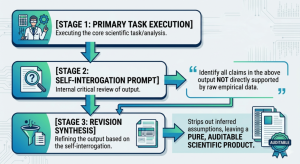
Doctoral Methodologies, Implementing the Protocol across the Research Lifecycle
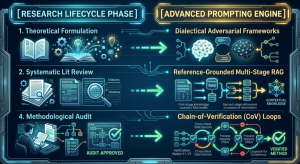
1. Theoretical Formulation
Instead of asking a Large Language Model to generate or support a hypothesis, doctoral researchers must deploy Tree-of-Thoughts (ToT) prompting engineered to act as an aggressive peer reviewer. The prompt restricts the AI from agreeing with the user.
2. Systematic Literature Reviews
When any one needs to solve problem which mostly related to context of research gap and gray area of research and citations, post-doctoral workflows which related to context, must move on from zero-shot knowledge retrieval. Researchers can build central new developed systems or feed exact text area into the context window using extensive meaningful boundary.
Markdown
3. Qualitative Coding & Data Processing
In any research and academic field, qualitative studies like thematic analysis or any semi-structured interviews and structured research can be used by researchers often face some reliability challenges of different outcome. For installing a Large Language Model into a reliable research processing, consistent methodology in helping hand, the research processing need some Semantic Logic which can be easily the model is details and more updated input-output pairs when anyone use the real dataset from different research field in different topics.
The Methodological Audit: Chain-of-Verification (CoV)
The final layer of mapping prompt engineering into post-doctoral work involves the execution of a Chain-of-Verification (CoV) architecture. Before any AI-generated data optimization is accepted into a research manuscript, the output must be run through an autonomous multi-stage audit loop.
Conclusion
Doctoral Methodologies can be named of Prompt Appendix as a New Academic Standard
Based on our analysis in 2026, the academic community is rapidly changing to a new mandate and target: the institutional changing of prompt transparency and prompt organogram.
Just as prior analysis of researchers had to include their statistical code matrices, field notes, or raw survey instruments, contemporary doctoral candidates must begin including a Doctoral Methodologies Prompt Appendix. Depend on research and analysis, every systematic review, qualitative data collection and process, or details data extraction driven by an Large Language Model must have its exact prompt architecture and prompt organogram, system constraints, API extra and big version of extra research parameters, and seed variables can fully documented in vast way.
On the conclusion stage we can say that, the managing and organizing prompt engineering for doctoral and post-doctoral methodologies stage from a casual discussion and interaction into a well organize and well structured, details methodology, doctoral and post-doctoral researcher & scholars can safely process the full cognitive leverage of generative AI and argentic AI—accelerating scientific research and research methodology can discover while preserving which is not the vulnerable accuracy needed by the international research arena and community.