
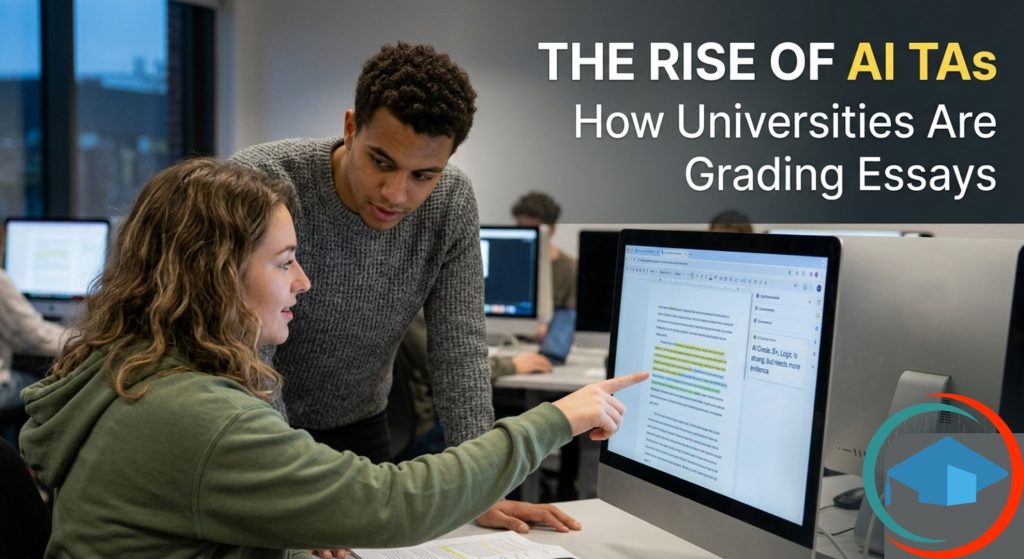
The Rise of AI Teaching Assistants (TAs): How Universities Are Grading Students
University students Essay Has a New Reader in future era, .. Its Not Human its some different system like artificial intelligence.
Imagine you spend three sleepless nights working on your 2,000-word essay. You finally submit it. Then a score appears on the screen within seconds. There are no notes from a professor in the margins. No red ink. Just a computer program checks student’s arguments, structure and vocabulary quickly.
We are now in 2026. AI Teaching Assistants are not something you see in science fiction movies anymore. They are already being used by your universities Learning Management System to evaluate your work check your citations and decide if your thesis is good enough.
This is a change in higher education. It has both bad effects. Universities are planning to do about what this means.
The Current Situation: AI TAs Are Already Here
The numbers show what is happening. A survey by EDUCAUSE in 2025 found that over 68% of universities are using AI-powered assessment tools. This is an increase from 31% in 2023. AI TAs are being used now.
In online courses AI-based grading tools checked over 27 million assignments in the first three months of 2025. AI feedback generators helped students rewrite their essays up to three times faster than if a teacher were checking them.
Some universities started using AI TAs a time ago. Georgia Tech used “Jill Watson”. An AI TA based on IBM Watson. In computer science classes at early as 2016, By 2023 Jill was answering over 10,000 questions per semester in eight classes. Collect the answers right 97.2% of the time.
For grading essays the technology has improved a lot. Turnitins AI grading system is now as good as a teacher at checking how well an essay is argued, how good the evidence is and how well it is written.
The technology that makes this possible, Natural Language Processing is the growing part of AI in education. It is growing at a rate of 36.64% per year. This is because people want to use chatbots and automated assessment tools.
Using AI tools also helps teachers with their workload. Teachers say they have 41% works to do when they use AI tools to manage exams. This is a thing because many departments do not have enough money and teachers are very busy.
The Main Problem: Efficiency vs. Educational Integrity
This is where things get complicated. Universities need to think about this.
The main problem is that AI grading systems are good at checking things that can be measured. They can check if the grammar is correct if the structure makes sense if the right keywords are used and if the citations are in the format.. They are not good at checking if a student has really learned something if they understand different cultures if they are willing to take risks or if they have new and original ideas.
This creates a problem. When students know that a computer will be grading their essays they start writing for the computer. They use the keywords. They structure their arguments in a way that the computer likes. They do not try to be original because that does not always get a score. The result is that students are learning how to cheat the system of becoming good writers.
Teachers say that students are using AI to write their essays. In 2026 12% of students were using AI to generate their essays. This is up from 8% in 2025. 3% In 2024. When a computer grades an essay that was written by a computer it does not make sense to have students write essays anymore.
There is also a problem with bias. AI models are trained on texts that already exist. These texts reflect the inequalities that already exist in the world. Students who do not write in English students who are not native English speakers and students who were taught to write in different ways may be treated unfairly by the system.
Automated grading systems are flagging 12.7% of assignments as plagiarism. This means that a teacher has to review them.. This affects students who are not native English speakers more than others. They may be using sentence structures that they learned in school. The computer thinks they are copying someone elses work.
Finally there is a problem with transparency. Most students do not know how AI grading systems work. They do not know what the computer is looking for or how to appeal a grade that they think is wrong. This creates an imbalance, in power. It is easy to argue with a teacher. It is difficult and complex to communicate or argue with a computer system.
Let’s Think About What Grading Is For
Before we try to fix things we need to take a step back and ask a basic question: what is the point of grading essays?
If grading is about making sure students meet a minimum standard then using artificial intelligence to help teachers is a good idea… If grading is about helping students learn and think critically then using machines to do it is a big mistake.
The problem is that universities might focus much on making things efficient and forget that grading is a way for teachers to help students learn and grow.. The students who need this help the most are the ones who are already at a disadvantage.
So What Can Universities Do About It

We do not need to get rid of intelligence completely. It is a tool and universities have a lot of pressure to make things more efficient.. We need to use it in a way that helps students learn not just makes things easier for the university.
- Use Artificial Intelligence To Help Teachers Not Replace Them. Artificial intelligence can do the pass of grading and flag any problems but a human teacher should always review the grade before it is final. Some research from 2025 says that using intelligence to help withgrading but still having ahuman teacher review it is a good way to make sure that students are treated fairly.
- Universities Need To Be Transparent About How Grading Works. Universities need to explain how artificial intelligence is used to grade essays what criteria are used and what students can do if they think their grade is unfair.
- Check For Bias Every Year. Every time a university uses intelligence to grade essays they need to check to make sure it is fair to all students no matter what their background is. The findings of these scrutinizing should be publicly known.
- Create Assignments That Are Hard For Machines To Do. Teachers need help creating assignments that require students to think and be creative things that are hard for machines to do.
- Teach Students About Artificial Intelligence. Of hiding the fact that artificial intelligence is used to grade essays universities should teach students how it works and what its limitations are. In 2026 students need to know how to use technology including artificial intelligence.
We Need To Be Careful About How We Use Technology
Using intelligence to grade essays is becoming more common and universities need to make sure they are using it in a way that is fair and helps students learn.
The use of intelligence is not inherently good or bad it depends on how it is used. If universities use it in a way that’s transparent, fair and helps students then it can be a useful tool.. If they use it just to save money and make things more efficient then it can hurt students.
Your essay deserves to be read by someone who understands what you are trying to say. The challenge for universities in 2026 is to make sure that artificial intelligence helps more humans do that, than replacing them altogether.